I love helping people remain safely and comfortably in their homes as they age. Aging in place can be deeply rewarding, but it is not the right—or financially realistic—solution for every family.
For some, a better option is to create a multigenerational home where an aging parent can live with an adult child while maintaining as much privacy and independence as possible. With the cost of senior housing and assisted living continuing to rise, this arrangement can offer important financial, practical, and emotional benefits.
For our family, it also gave us something priceless: more time together.

When we remodeled our home, we knew my wife’s parents—“Granny and Boppa” to our children—would be moving in with us. Our household would include two young adult children, two aging parents, and my wife and me.
Our design brief was “Cabin Chic.” We wanted a home that felt warm and inviting, with rich textures, comfortable gathering areas, and open spaces. At the same time, we needed enough privacy for six people to live together without feeling as though we were always on top of one another.
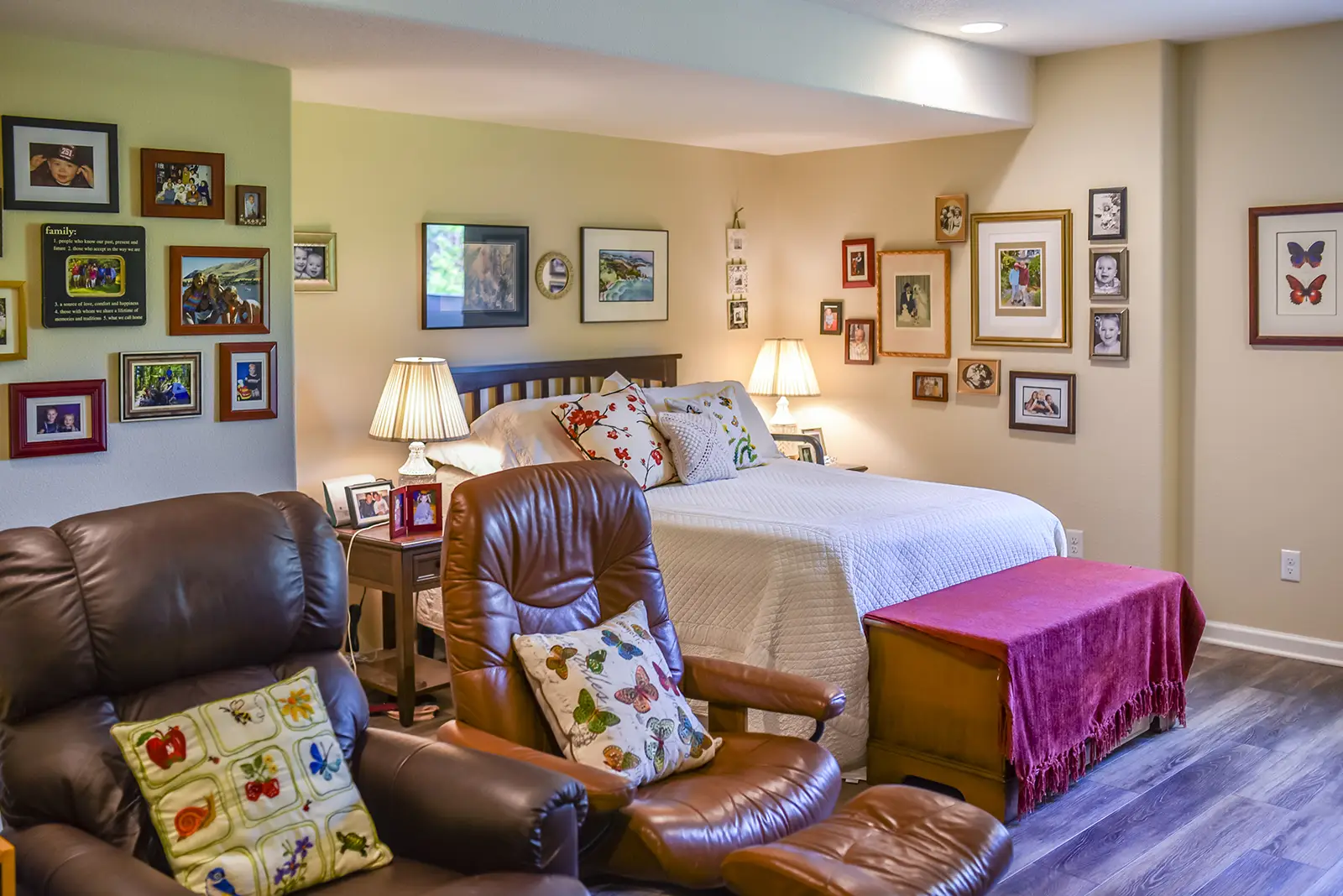
We converted our daylight basement into a private suite for Mom and Dad and installed a stair lift to provide safe access. Their suite included:
The rest of the house was designed with the same balance in mind. We created places where our children could spend time with friends, comfortable corners for quiet time, and gathering spaces large enough for the entire family.
That separation was essential. Mom and Dad could have breakfast, drink their coffee, and watch Good Morning America in their suite while the rest of us scrambled to get ready for school and work. At the end of the day, we could come together for a glass of wine and dinner as a family.
We were living together, but everyone still had a place of their own.
As a Certified Aging-in-Place Specialist and remodeling contractor, I understood the principles of accessible design. Living with Mom and Dad gave me a much deeper appreciation for how those principles work in everyday life.
The details that may appear minor during design can become incredibly important when someone’s mobility declines or professional caregivers become involved.
Wide pathways make it easier to use a walker or wheelchair. A curbless shower reduces fall risk and allows a caregiver to provide assistance. Durable, smooth flooring makes movement easier. Adequate space around the bed, toilet, and shower can help caregivers work more safely and preserve the dignity of the person receiving care.
As Mom and Dad’s needs increased, we hired in-home caregivers. Several members of their care teams told us how much easier our home made their jobs. That meant a great deal to me—not only professionally, but personally. The home was doing what we had designed it to do: supporting Mom and Dad, our family, and the people helping us care for them.
As parents age, traveling and maintaining their independence can become increasingly difficult. Instead of always traveling to see Mom and Dad, we were able to share everyday life with them.
They moved in during the COVID era, when many families were separated from aging parents. Because we lived together, our children continued to have regular, unrestricted time with Granny and Boppa.
We had planned for them to live with us for approximately ten years. In reality, we had only a couple of years together before they passed away. Although that was much less time than we expected, we are profoundly grateful that we shared those final years as a family.
Living with us cost Mom and Dad considerably less than many senior housing or assisted-living options. They paid rent and contributed toward utilities, food, and other household expenses.
They also used a portion of the proceeds from selling their previous home to help fund the part of the remodel created for them. Even after that contribution, they retained equity from the sale.
Every family’s finances are different, but a thoughtfully planned remodel may create long-term value while giving aging parents a more affordable and personal living arrangement.
Multigenerational living creates opportunities that occasional visits cannot always provide. Our children shared meals, conversations, ordinary mornings, and family traditions with their grandparents.
Those everyday moments became some of the most meaningful benefits of the entire experience.
When Mom’s health began to fail, our home was prepared to accommodate hospice care.
Losing someone you love is never easy, but being able to remain together at home allowed us to share that final stage of her life in a peaceful and personal way. It was one of the most difficult experiences our family has faced, but it also included moments of extraordinary closeness.
Before moving in, Mom and Dad were doing everything they could to remain independent in their own home. Looking back, we realized they had been operating in survival mode.
Once they were safely living with us, it seemed as though they could finally let down their guard. At the same time, the full extent of their health challenges became more apparent. Their needs increased much faster than we anticipated.
A multigenerational home should therefore be designed not only for someone’s current abilities, but also for how those abilities may change.
My wife and I were busy professionals. We wanted to care for Mom and Dad, but as their needs intensified, we could not safely or sustainably do everything ourselves.
We eventually hired in-home caregivers, which was expensive but necessary. Having a home designed to support professional care proved invaluable.
Families considering this arrangement should discuss more than the remodel. They should also consider who will provide care, what outside support may be needed, how much it could cost, and how responsibilities will be shared.
Mom and Dad began alternating between hospitals, rehabilitation facilities, and home. One would experience a health crisis, return home, and then the other would need care.
We lost Mom in March and Dad in June of the same year. That one-two loss was incredibly difficult. It reminded us that even the best plans must remain flexible.
We had planned for ten years together. We received two. The remodel still mattered because it helped us make those years safer, closer, and more meaningful.
Mom and Dad began updating their estate plan as they moved in with us, but it was never completed. Their health problems escalated, and medical decisions quickly took priority.
Estate planning, powers of attorney, healthcare directives, financial responsibilities, and end-of-life wishes should be addressed while everyone is able to participate fully. These conversations can be uncomfortable, but delaying them can create far greater difficulty later.
Families should work with qualified legal and financial professionals to complete these plans before a crisis occurs.
Multigenerational living does not simply mean adding a bedroom for a parent. It means sharing your home, routines, and personal space.
Mom and Dad needed privacy, and so did my wife and I. Our children also needed places where they could live their own lives and spend time with friends.
Separate living areas, good sound control, an additional kitchenette, private bathrooms, and clearly defined gathering spaces can make the difference between merely fitting everyone into a house and creating a home where everyone can thrive.
Before moving in together, families should discuss expectations openly. Important questions include:
It is much easier to reach an understanding before the move than during a stressful health event.
I strongly believe in multigenerational living, but I also know it is not right for every family—or every house.
Success requires more than accessible features. It requires thoughtful design, honest communication, financial planning, privacy, flexibility, and a realistic understanding of future caregiving needs.
Our experience changed the way I approach aging-in-place and multigenerational remodeling. I understand these projects not only as a contractor, but also as a husband, father, and son-in-law who has lived through the rewards and challenges firsthand.
EverLife Home can help you determine what is possible in your home and design a space that supports independence, caregiving, privacy, and family connection. We can also share the practical lessons we learned so that your family can approach multigenerational living with clearer expectations and greater confidence.
Done well, this type of remodel does more than make room for another generation. It creates a home that helps a family care for one another through every stage of life.
Keith Knowles
President, EverLife Home
.svg)


